Join RoboRithm 2025!
Registration is now Open
Count Down
Days
Hours
Minutes
Seconds
Show your Skills!
CENTRAL LUZON’S BIGGEST ROBOTICS COMPETITION
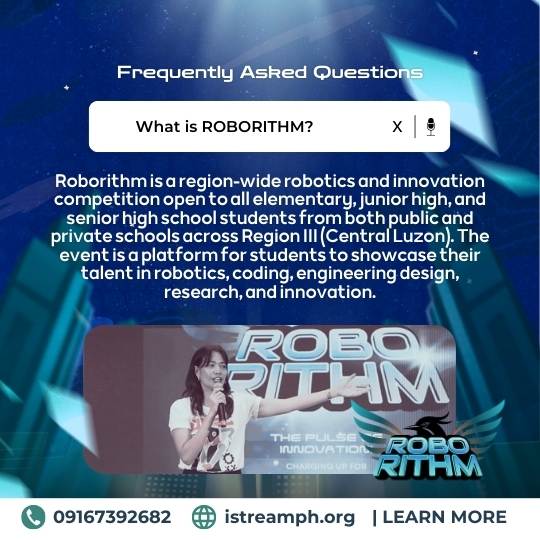
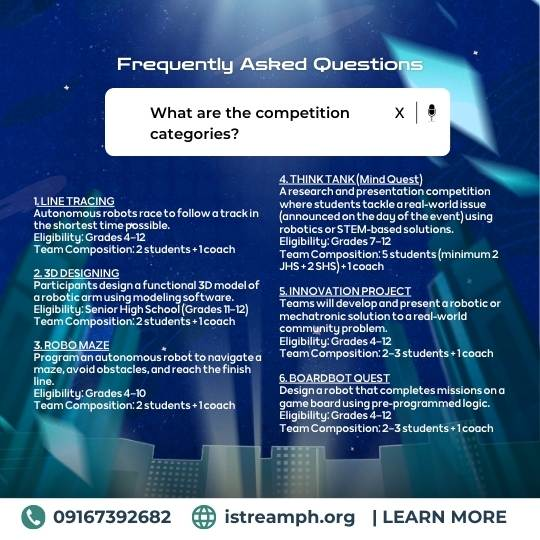
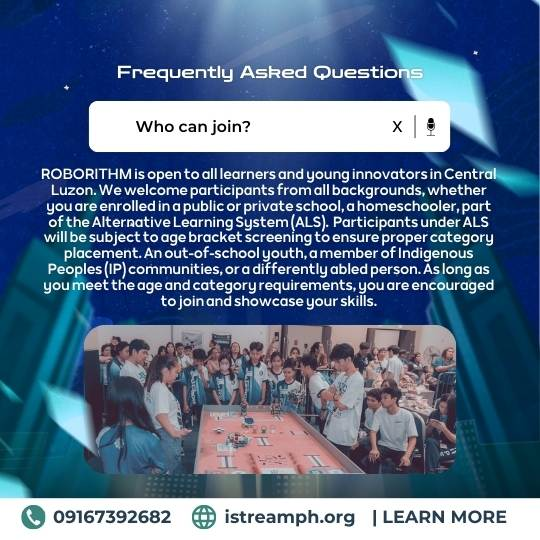
Robortihm is a signature initiative by ISTREAM EDUCATION that blends robotics, algorithmic logic, and research-based problem solving into one dynamic student experience. Designed for young innovators grade 4–12, this program challenges students to build smart robots powered by creativity and innovation.
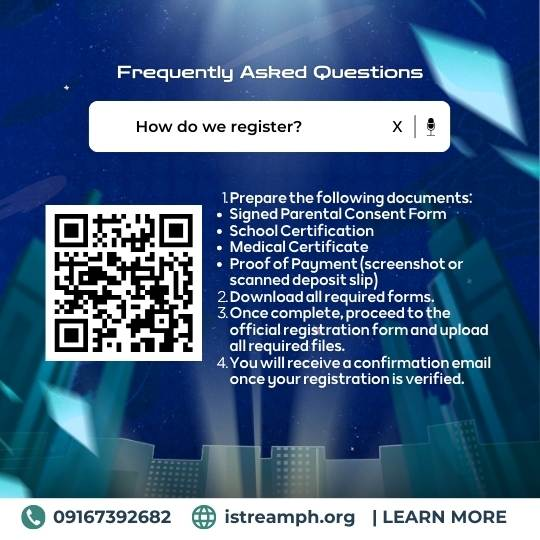
Gather the following
Requirements
NOTE: information and requirements may be adjusted.
Sign-up to your category of choice


Objective
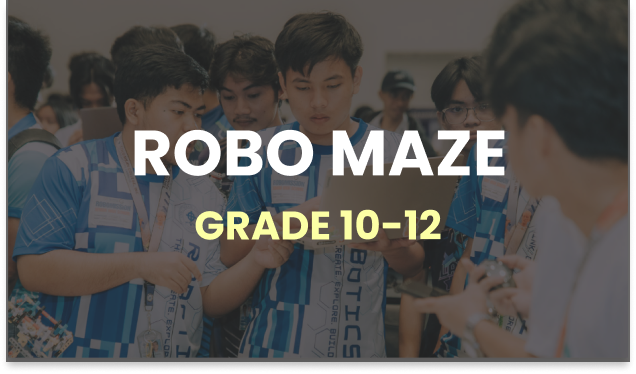
- Designing a robot that can autonomously detect and follow paths
Programming the robot to detect and avoid obstacles
Navigating dynamic turns, dead ends, and timed checkpoints
Optimizing for speed vs. precision (balancing logic with efficiency)
Requirements
| Category | Details |
|---|---|
| Grade Level | Grades 4 to 12 |
| Team Size | 2 students 1 coach |
| Robot Type | to be announced. |
| Tools/Skills | to be announced. |
FAQs
Q: Are custom-built robots allowed?
A: Absolutely, in fact they are a necessity. Students will build and code their own robots using any platform that meets the safety and competition guidelines.
Q: Can teams use AI or machine learning techniques?
A: Yes, as long as the implementation is student-developed and explainable during judging. AI-based logic is accepted if relevant to the maze challenge.
Q: Is remote control allowed during the run?
A: No. Robots must operate autonomously once started. All decision-making must be pre-programmed and handled by onboard systems.
Q: Will there be a tech inspection before competing?
A: Yes. All robots must pass a technical inspection to confirm compliance with safety, size, and autonomy standards.
Q: How is scoring done?
A: Scoring is based on maze completion time, obstacle handling, code logic quality, and accuracy. Penalties apply for missed checkpoints or manual intervention.
Objective
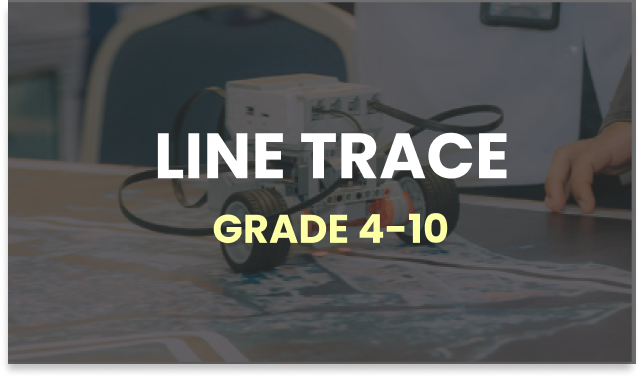
Autonomous robots race to follow a track in the shortest time possible
Requirements
| Category | Details |
|---|---|
| Grade Level | Grades 4 to 12 |
| Team Size | 2 students 1 coach |
| Robot Type | to be announced. |
| Tools/Skills | to be announced. |
FAQs
Will there be a technical inspection?
A: Yes. All robots will undergo a technical inspection before competing to ensure compliance with safety, size, and autonomy rules.
Q: How will the scoring work?
A: Scoring is based on completion time, track-following accuracy, and smooth navigation. Penalties will be applied for going off track, missing checkpoints, or manual intervention.
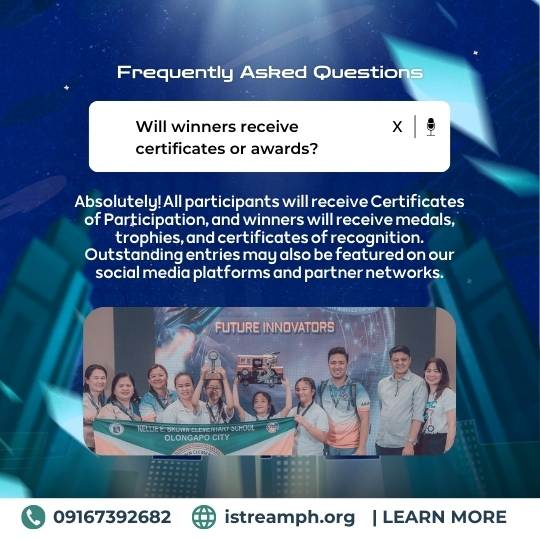
Q: Will winners receive certificates or awards?
A: Absolutely! All participants will get Certificates of Participation, while winners will receive medals, trophies, cash prizes, and Certificates of Recognition. Outstanding entries may also be featured on our social media platforms and partner networks.
Objective
Design a robot that completes missions on a game board using pre-programmed logic.
Requirements
| Category | Details |
|---|---|
| Grade Level | Grades 4 to 12 |
| Team Size | 2-3 students 1 coach |
| Robot Type | to be announced. |
| Tools/Skills | to be announced. |
FAQs
Q: Can a coach handle more than one team?
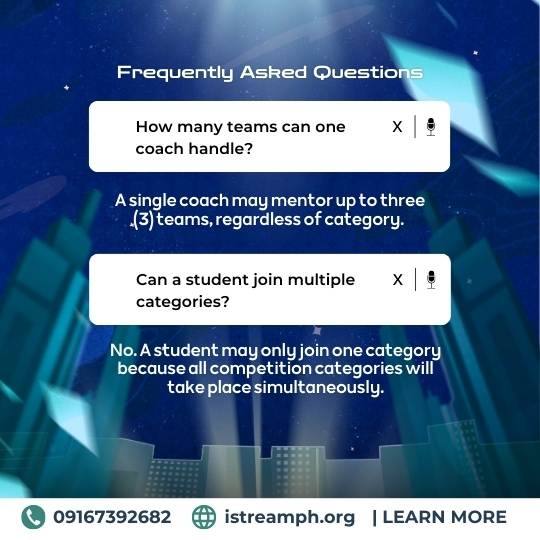
A: Yes. A single coach may mentor up to three (3) teams, regardless of category.
Q: Can students join more than one category?
A: No. All categories will be held simultaneously, so a student may only join one category.
Q: What types of robots can be used?
A: LEGO will be the platform for this competition.
Objective
- Designing a robot that can autonomously detect and follow paths
Programming the robot to detect and avoid obstacles
Navigating dynamic turns, dead ends, and timed checkpoints
Optimizing for speed vs. precision (balancing logic with efficiency)
Requirements
| Category | Details |
|---|---|
| Grade Level | Grades 11 to 12 |
| Team Size | 2 students 1 coach |
| Robot Type | to be announced. |
| Tools/Skills | to be announced. |
FAQs
Q: What software can be used?
A: Any 3D modeling software may be used, such as Autodesk Fusion 360, SolidWorks, TinkerCAD, or Blender, provided the final file format meets the competition guidelines.
Q: What is the required format for submission?
A: As of now, there is no fixed submission format. The official guidelines for file type, naming convention, and submission process will be announced to registered teams closer to the competition date.
Q: How will entries be judged?
A: Judging will consider creativity, functionality, technical accuracy, feasibility for real-world use, and the quality of the final presentation.
Objective
A research and presentation competition where students tackle a real-world issue (announced on the day of the event) using robotics or STEM-based solutions.
Requirements
| Category | Details |
|---|---|
| Grade Level | Grades 7 to 12 |
| Team Size | 5 students (minimum 2 JHS + 2 SHS) + 1 coach |
FAQs
Q: Are custom-built robots allowed?
A: Absolutely. Students may build and code their own robots using any platform that meets the safety and competition guidelines.
Q: Can teams use AI or machine learning techniques?
A: Yes, as long as the implementation is student-developed and explainable during judging. AI-based logic is accepted if relevant to the maze challenge.
Q: Is remote control allowed during the run?
A: No. Robots must operate autonomously once started. All decision-making must be pre-programmed and handled by onboard systems.
Q: Will there be a tech inspection before competing?
A: Yes. All robots must pass a technical inspection to confirm compliance with safety, size, and autonomy standards.
Q: How is scoring done?
A: Scoring is based on maze completion time, obstacle handling, code logic quality, and accuracy. Penalties apply for missed checkpoints or manual intervention.
Objective
Teams will develop and present a robotic or mechatronic solution to a real-world
Requirements
| Category | Details |
|---|---|
| Grade Level | Grades 4 to 12 |
| Team Size | 2–3 students + 1 coach |
FAQs
Q: Can teams use AI or machine learning techniques?
A: Yes, as long as the implementation is for brainstorm purposes and explainable during judging. AI must be correctly cited when utilized.
Q: How is scoring done for the Think Tank category?
A: Teams will be evaluated on the innovation and originality of their idea, the technical feasibility of their design, its relevance to real-world problems, the quality of their presentation, and the completeness of their documentation. Judges will also consider how clearly the team can explain and defend their solution during the Q&A.
Frequently Asked Questions


Collaborators